I've torn apart decks that cost $30,000 to build and lasted seven years. I've seen $18,000 decks going strong after twenty. The difference wasn't materials or size. it was five specific construction details that most homeowners never see and many builders skip.
Detail #1: The Ledger Board
This is where your deck attaches to your house. It's also where most deck failures originate.
Why It Matters
The ledger board carries roughly half your deck's weight. It's also the most vulnerable point for water infiltration. Get it wrong, and you're not just losing a deck. you're rotting your house's rim joist, potentially requiring $15,000+ in structural repairs.
What Goes Wrong
The Right Way
| Component | Minimum | What We Do |
|---|---|---|
| Fasteners | 1/2" lag bolts @ 16" o.c. | Structural screws, staggered pattern |
| Flashing | Z-flashing at top | Full pan flashing with drip edge |
| Spacing | 1/2" from siding | Standoff spacers + 1" drainage gap |
| Sealant | Silicone at penetrations | Butyl tape behind ledger + sealant |
Cost premium: $250-500
What you avoid: $5,000-25,000 in house damage
Detail #2: Footing Depth
Frost depth matters here. The Ashtabula County deck information guide currently asks you to indicate a 40-inch frost-protection depth when applicable, and the approved design plus site conditions control the actual footing size and depth.
Why Depth Matters
If footings sit shallower than the site really needs, frost movement can reach them during severe winters. The deck heaves slightly. Posts shift. Railings loosen. After a few cycles, nothing is quite level or tight anymore.
What We Recommend
| Deck Height | Typical Approach |
|---|---|
| Ground level | Frost-protected footings per the approved design |
| 4-8 feet | Frost-protected footings sized for the loads in the approved design |
| Multi-level | Engineered footings or helical piers per the approved design |
Helical piers are worth mentioning: engineered steel screws that we twist into the ground to predictable load capacity. More expensive (illustrative planning figures, not quotes: roughly $175-300 per pier vs. $60-100 for conventional concrete footings; actual local pricing varies), but no concrete curing, no frost heave issues, and verifiable load ratings.
Detail #3: Joist Blocking
Walk across most decks and you'll feel some bounce. That's not normal, it's missing blocking.
Blocking consists of short pieces of lumber installed perpendicular to joists. It prevents twisting, distributes weight, and eliminates that springy, trampoline feel.
When You Need It
What Proper Blocking Includes
Cost: $300-900 depending on deck size
Payoff: Eliminates bounce, extends structural life by a decade or more
Detail #4: Hardware and Fasteners
Lake Erie is fresh water, so there is no salt exposure here. What does matter is moisture: humidity, wind-driven rain and snow, and repeated wetting, drying, and freeze-thaw cycles. Combined with the chemistry of modern treated lumber, that can accelerate corrosion on hardware that isn't properly rated.
I've seen deck hardware corrode years earlier than it should have, simply because the wrong fasteners were used.
Choosing the Right Hardware
Fasteners and connectors must be compatible with treated lumber and rated for the exposure conditions. Depending on the approved design, the connector manufacturer's requirements, and applicable code, hot-dipped galvanized or stainless steel may be appropriate. Mixing incompatible metals is what causes most premature failures.
Locations Worth Extra Attention
Investment: Corrosion-resistant hardware typically adds a few hundred dollars to a deck build, and it is cheap insurance against early replacement.
Detail #5: Board Spacing and End Sealing
Two small details with outsized impact on how your deck weathers and ages.
Board Spacing
Improper gaps cause two problems:
| Material | Gap Between Boards | Notes |
|---|---|---|
| Pressure-treated (wet stock) | 1/16" | Will shrink as it dries |
| Pressure-treated (kiln-dried) | 3/16" | Stable dimension |
| Composite | Per manufacturer | Usually 3/16-1/4" |
| PVC | Per manufacturer | Usually 1/8" |
End Sealing
When you cut pressure-treated lumber, you expose untreated wood fibers. Water wicks in. Rot begins from the inside.
The fix: Brush end-cut preservative on every single cut end. Takes 30 seconds per cut. Costs $15-30 per deck. Adds years to board life.
Most builders skip this. Ask specifically if they do it.
The Inspection Checklist
Use this when evaluating contractor proposals or checking an existing deck:
Structural:
Materials:
Finish:
What This Costs (And Why It's Worth It)
Quality deck construction runs 15-25% more than budget builds:
| Detail | Savings Approach | Quality Approach | Premium |
|---|---|---|---|
| Footings | Conventional concrete footings per approved design | Deeper footings or helical piers | +$500-1,200 |
| Ledger | Lag bolts, Z-flash | Structural screws, pan flashing | +$250-500 |
| Blocking | None/minimal | Full blocking | +$300-900 |
| Hardware | Standard galvanized | Stainless/HD galv | +$250-700 |
| Finish | Skip end sealing | Full end treatment | +$50-100 |
The premiums above are illustrative planning figures used in this article, not current quotes. Actual local pricing varies by design, materials, access, and market conditions.
Total premium: $1,350-3,400
Lifespan improvement: 12-18 additional years
Effective cost: Under $100/year for a deck that performs decades longer
Our Standard Practice
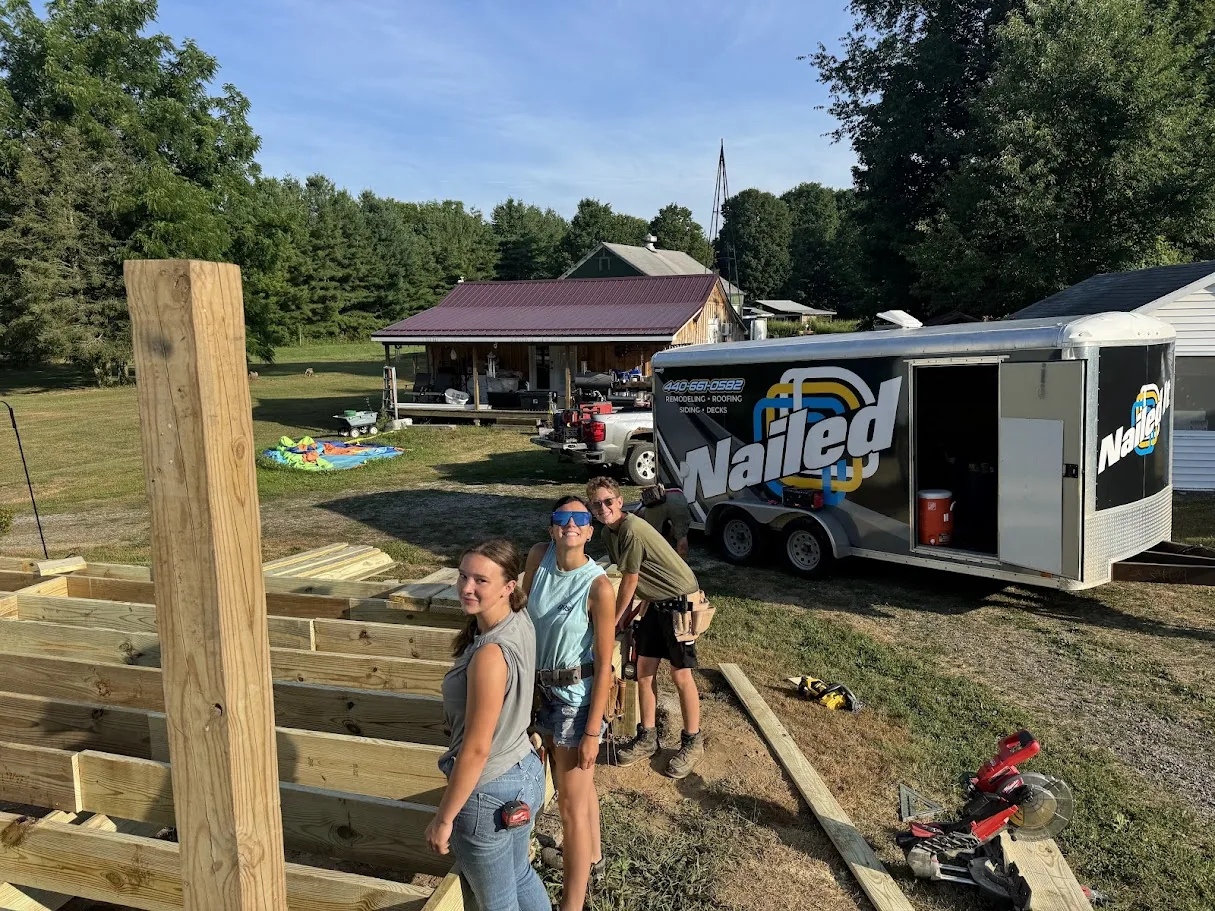
At Nailed It 440, these details aren't upgrades, they're baseline:
We build decks the way we'd build them for ourselves.
📞 Call (440) 224-4121 for a free deck estimate.
Related Services
Planning a project in Ashtabula County? Explore the services tied to this article.
Ready to Get Started?
Get a free, no-obligation estimate for your project. We'll discuss your vision, timeline, and budget, then show you exactly what's possible.