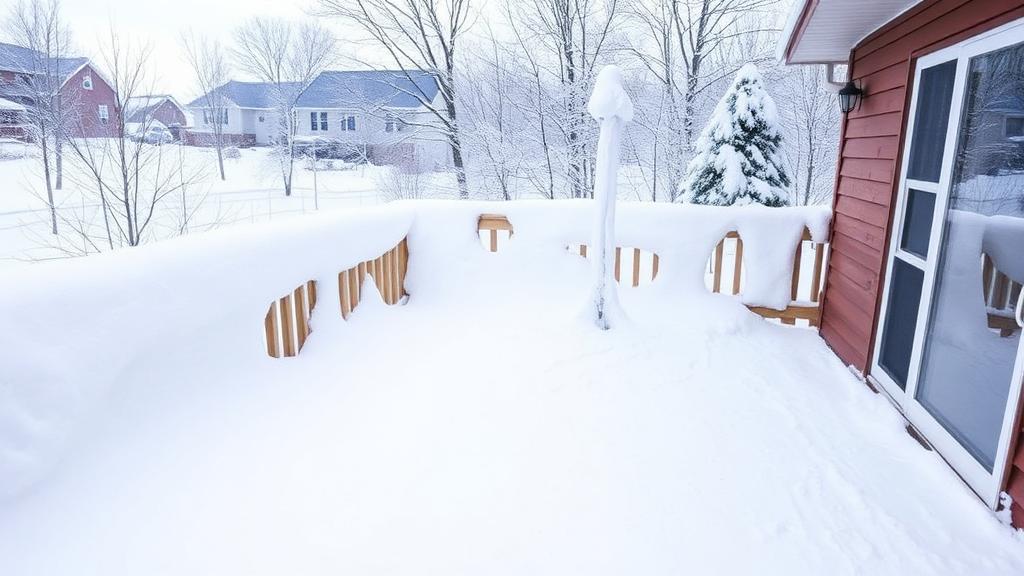
December 2022. Saybrook Township. Sixty-three inches of snow in 48 hours.
That's not a typo. Lake-effect storms don't mess around in Ashtabula County, and your deck is directly in the crosshairs.
I've inspected decks across Geneva, Conneaut, Kingsville, and everywhere in between. After every major storm, the calls start: sagging joists, split boards, railings that wobble, ledger boards pulling away from houses. Most of this damage was preventable.
Understanding What Snow Does to a Deck
People underestimate snow weight. It's not light and fluffy like the postcards.
Fresh, dry powder: 3-5 pounds per square foot, per foot of depth.
Wet lake-effect snow: 15-20 pounds per square foot, per foot of depth.
Packed, icy snow: 25+ pounds per square foot.
Run the numbers on a 300-square-foot deck with two feet of wet snow: 9,000 to 12,000 pounds. That's two pickup trucks parked on your deck.
Standard residential decks are engineered for 40-50 pounds per square foot live load. A heavy lake-effect event can push structures right to the edge of design limits. or past them.
The Three Ways Winter Kills Decks
1. Structural Overload
When weight exceeds design capacity, things bend, crack, and fail:
2. Freeze-Thaw Cycling
Lake Erie moderates our temperatures, which sounds nice until you realize it creates constant freeze-thaw cycles.
Water enters wood grain → freezes → expands → creates micro-cracks → thaws → sinks deeper → freezes again.
Repeat fifty times per winter. By spring, wood that looked fine in October has checking, splitting, and early-stage rot.
3. Trapped Moisture
Snow piles against railings. Ice forms at the ledger connection. Water pools anywhere there's a slight depression.
Moisture against wood = decay. Moisture against hardware = corrosion. Moisture getting inside your house = expensive repairs.
What to Watch For
Immediately after major storms:
In spring:
If you notice any ledger separation, stop using the deck immediately. This is how collapses happen.
Building for Lake-Effect Country
If you're replacing a deck or building new, upgrade for our climate:
| Component | Standard Build | Lake-Effect Build |
|---|---|---|
| Joist spacing | Wider spacing | Tighter spacing where the design supports it |
| Joist size | 2x8 | 2x10 |
| Post size | 4x4 | 6x6 |
| Footing depth | Per approved design | Per approved design, frost-protected |
| Hardware | Galvanized | Stainless or hot-dipped |
The premium: $2,000-5,000 more on a typical 300-square-foot deck.
The payoff: 15+ additional years of service life. No structural anxiety during February snowstorms.
Materials That Handle the Abuse
Pressure-treated lumber: Still the value play at $18-25/square foot installed. Requires annual maintenance. Will show wear after 10-15 years in our climate but remains structurally sound longer.
Composite (Trex, TimberTech, Fiberon): $28-45/square foot installed. Won't rot, split, or splinter. Can get slippery when icy. look for products with enhanced slip resistance.
PVC (Azek, TimberTech Pro): $40-55/square foot installed. Zero moisture absorption. A strong option for shoreline properties exposed to high humidity and wind-driven moisture.
Maintenance That Actually Matters
Before winter (October-November):
During winter:
Spring inspection:
Repair Costs (2025 Rates)
| Issue | Cost Range |
|---|---|
| Board replacement (wood) | $8-15 each |
| Board replacement (composite) | $20-35 each |
| Joist reinforcement | $500-2,000 |
| Ledger board repair | $1,200-3,500 |
| Railing rebuild | $800-2,500 |
| Full structural repair | $3,000-10,000+ |
When to replace instead of repair: If more than 40% of components need work, or if structural members are compromised, rebuilding usually makes more financial sense.
Free Deck Inspections
We offer free deck evaluations throughout Ashtabula County. We'll give you an honest assessment, even if that means telling you everything looks fine.
📞 Call (440) 224-4121 or schedule online.
Related Services
Planning a project in Ashtabula County? Explore the services tied to this article.
Ready to Get Started?
Get a free, no-obligation estimate for your project. We'll discuss your vision, timeline, and budget, then show you exactly what's possible.